Drought is again becoming a serious issue across much of the United States.
Farmers are dealing with reduced water availability and difficult growing conditions. Reservoir levels across parts of the West remain low. Mines and industrial facilities operating in water-constrained areas are paying increasingly close attention to where their water comes from and how much they use.
As of August 2026, drought conditions extend across a significant portion of the country. In the West, Lake Mead and Lake Powell remain at historically low levels. Agriculture is feeling the effects as well, with drought contributing to poor crop conditions and reduced production in several important growing regions.
There is no simple answer to a problem this large. More efficient irrigation, water reuse, groundwater management, conservation, recycling, and new infrastructure will all be needed.
But there is one source of water loss that is sometimes overlooked. The water already sitting in storage is evaporating.
For a mine, farm, industrial facility, municipality, or other operation that relies on stored water, that loss can be surprisingly large. A floating evaporation cover like EnviroBalls™ is one of the more practical ways to address it.
Water in Storage Has Already Cost Something
It’s easy to look at a pond or reservoir and think of the water as simply being there.
A farmer may have pumped that water from a well or diverted it during a limited period when water was available. A mine may have captured, treated, pumped, recycled, or purchased its water. An industrial facility may have significant treatment and energy costs invested in the water stored on site.
In each case, that water has value before it ever reaches the pond.
Once stored in an open reservoir, it’s exposed to sun, wind, heat, and dry air. In many western climates, several feet of water can be lost from an exposed surface over the course of a year.
That turns into a very large volume of water:
- 1 acre-foot is approximately 326,000 gallons
- A 1-acre pond losing 6 feet a year loses nearly 2 million gallons
- A 10-acre pond at the same rate loses nearly 20 million gallons
- A 50-acre pond loses nearly 100 million gallons
Those numbers get attention quickly when the water has to be pumped out of the ground, purchased, treated, or replaced.
Mine Water Evaporation: A Growing Cost in Nevada, Arizona, and Other Arid Mining Regions
Water management has always mattered to mining, particularly in arid parts of the United States, including Nevada, Arizona, and other Southwestern states, as well as South America, Australia, and other major mining regions. It’s becoming even more important.
Mines can have substantial volumes of water stored in process-water ponds, reclaim ponds, freshwater reservoirs, lined storage ponds, and other engineered basins. Many of these facilities sit in areas with high solar radiation, low humidity, wind, and limited rainfall. Those are exactly the conditions that drive significant evaporation.
Mining companies have already made considerable progress recycling and reusing process water, which makes sense. Water that’s difficult or expensive to obtain should be used as efficiently as practical. Evaporation deserves the same scrutiny.
If a mine pumps groundwater into a storage reservoir and then loses a portion of it to the atmosphere, additional water has to be pumped to replace that loss. That means more pumping, more energy, and more demand on the source. Where water rights or permitted withdrawals are limited, the value of preserving that water is even greater.
The question for a mine isn’t simply what a gallon of water costs. It’s what that gallon costs to replace.
Irrigation Pond Evaporation: A Problem for Farmers in Drought-Prone Regions
The economics are different for agriculture, but the basic problem is the same.
Irrigation ponds and reservoirs let farmers store water when it’s available and use it when crops need it. During drought, whether in California’s Central Valley, the Texas Panhandle, or other water-stressed growing regions, that stored supply becomes especially valuable.
Unfortunately, the hot, dry conditions that increase irrigation demand also increase evaporation. A farmer may be losing stored irrigation water at the exact moment crops need it most.
For smaller agricultural reservoirs, losses add up quickly. A 5-acre irrigation pond losing 5 feet of water annually loses roughly 8 million gallons to evaporation.
Not every gallon of that loss can practically be eliminated. But preserving even a portion of it could mean less groundwater pumping, more water available late in the growing season, or a larger reserve when drought conditions persist. In areas where wells are declining or allocations are tightening, that matters.
Ready to see what your reservoir is losing? [Request a free evaporation estimate]
The Same Economics Apply to Industry
Mining and agriculture are the obvious examples, but they aren’t the only industries storing valuable water.
Manufacturing facilities, power plants, wastewater facilities, food processors, data centers, utilities, chemical plants, refineries, and other industrial operations may maintain open ponds or reservoirs for process water, recycled water, cooling water, treated water, stormwater, or emergency storage.
The first question should always be what this water is worth to the operation.
If water is plentiful and inexpensive to replace, evaporation reduction may not be a priority. If the facility is pumping groundwater, purchasing water, treating it before storage, operating under withdrawal limits, or struggling with availability, the calculation looks very different.
This is why evaporation control shouldn’t be evaluated purely as an environmental measure. In many applications, it’s an operating-cost and water-security issue.
Can Floating Water Covers Reduce Evaporation?
One way to reduce evaporation is to reduce the amount of water surface directly exposed to the atmosphere.
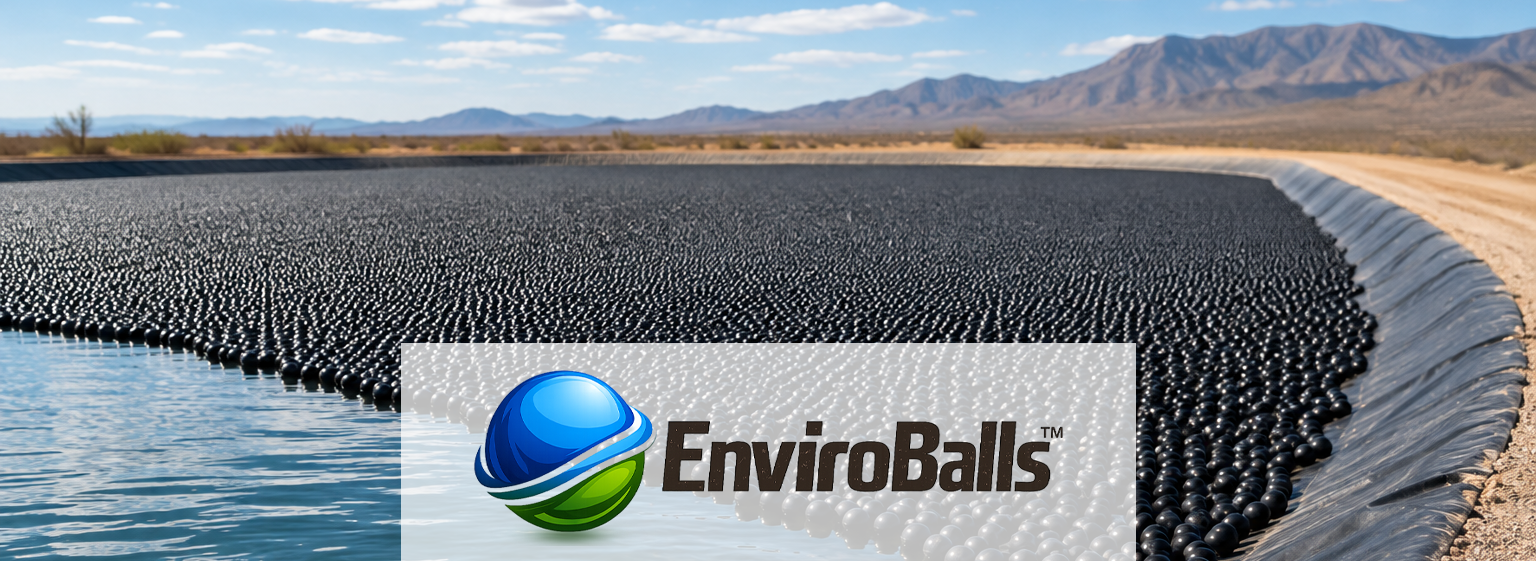
Floating covers do this by creating a physical barrier across the water surface. Modular systems using floating spheres, such as EnviroBalls™, can adapt to changing water levels without the structural support a conventional roof or fixed cover would require.
The concept is simple. Reduce exposed water surface, and you reduce the interaction between water, solar radiation, wind, and dry air that drives evaporation.
Independent field studies of floating sphere systems have reported meaningful evaporation reductions, though actual performance varies with climate, coverage, wind, pond geometry, and operating conditions. Because of that variability, we don’t assume the same reduction for every site. The first step is always estimating how much water a given pond is actually losing.
Start With the Water Balance
Before considering a cover, an operator should know approximately how much water is being lost and what that water is worth.
For a preliminary analysis, we typically start with a few basic inputs:
- Location
- Surface area
- Local climate
- Source of water
- Difficulty or cost of replacing that water
From there, annual evaporation can be estimated and converted into gallons lost per year. That figure is then compared against the expected reduction from a floating cover and the cost of installing the system. For some ponds, the economics won’t work. For others, particularly in dry climates where water is pumped, treated, purchased, or limited, the volume of water at stake can justify a much closer look.
Where Floating Covers Make the Most Sense
The strongest potential is in engineered ponds and reservoirs where water has a measurable operational value, including:
- Mine process-water and freshwater ponds
- Agricultural irrigation reservoirs
- Industrial water-storage ponds
- Municipal storage basins
- Recycled-water reservoirs
- Treated wastewater storage
- Power-generation facility reservoirs
Large natural lakes are a very different problem. Covering Lake Mead or Lake Powell isn’t what we’re suggesting. But there are thousands of smaller engineered reservoirs where covering the water surface is practical enough to evaluate, and collectively those smaller ponds represent a significant amount of stored water.
Drought Changes the Value of the Water You Already Have
The important issue isn’t simply whether drought gets better or worse next year. Water demand is growing in many parts of the country while groundwater, surface-water allocations, infrastructure, and competing users constrain available supply.
Mining offers a good example. New critical-mineral projects are being proposed in some of the driest parts of the United States, and water availability is increasingly part of that development conversation.
Agriculture has dealt with this problem for far longer. When water becomes scarce, farmers face difficult decisions about acreage, irrigation, crops, and pumping.
Industry faces its own version of the same problem. In all three cases, conservation usually starts with reducing how much water is used. It should also include looking at how much stored water is being lost.
Sometimes the Best New Water Supply Is Water You Don’t Lose
Evaporation control won’t solve drought. It won’t refill the Colorado River, replace groundwater management, or eliminate the need for more efficient water use.
But that doesn’t make the losses unimportant.
- If a mine preserves millions of gallons of process or freshwater annually, that water doesn’t have to be replaced.
- If a farmer retains more irrigation water through the hottest part of the growing season, that water stays available for crops.
- If an industrial facility reduces losses from a storage reservoir, it may reduce how much water has to be purchased, pumped, or treated.
There’s real value in each of those outcomes. We spend a great deal of money finding, pumping, transporting, treating, and storing water. It makes sense to look at what happens to it once it reaches the pond. Get started with GES today.
Common Questions About Evaporation and Industrial Water Storage
How much water can an open pond lose to evaporation? It depends on location, temperature, solar radiation, humidity, wind, elevation, and other conditions. In dry climates, annual evaporation can amount to several feet of water depth. Every foot of evaporation represents approximately 326,000 gallons per acre of water surface. Six feet of evaporation can mean nearly 2,000,000 gallons of water lost per year across one acre of stored water.
How much water could a mine lose from a process-water pond? The answer depends primarily on pond area and local evaporation conditions. For example, a 20-acre pond experiencing six feet of annual evaporation would have a gross evaporation loss of approximately 40 million gallons per year.
Can floating covers be used on mine water ponds? Yes. Floating covers can be evaluated for process-water ponds, freshwater storage, reclaim-water ponds, and other engineered mining reservoirs. Water chemistry, operating conditions, wind, pond geometry, equipment access, and other site-specific factors need to be considered.
Can evaporation covers reduce irrigation water losses? Yes. Agricultural reservoirs can lose significant volumes of stored irrigation water to evaporation, particularly in hot, dry climates. The economics depend on the evaporation rate, pond size, value of the stored water, and cost of the cover.
Does reducing evaporation also reduce pumping costs? It can. When evaporated water must be replaced with pumped groundwater or another pumped supply, preserving stored water can reduce the volume that needs to be replaced, along with the associated pumping requirement.
What industries could benefit from floating water covers? Potential applications include mining, agriculture, municipal water, wastewater, power generation, manufacturing, food processing, chemical processing, refineries, and other operations with open water-storage ponds or reservoirs.
How do I know whether an evaporation cover makes economic sense? Start by estimating annual evaporation in gallons and determining the cost or operational value of replacing that water. Compare those losses against the expected performance, installed cost, and useful life of a floating cover.
How Much Water Is Your Pond Losing?
Global Environmental Solutions can perform a preliminary evaporation assessment for a mine, farm, industrial facility, municipality, or other operation with an open water-storage pond. Contact GES today.
We start with the location and approximate surface area of the pond and estimate the potential annual evaporation loss. For sites that warrant additional analysis, we can then evaluate the potential water savings associated with a floating cover such as EnviroBalls™.
If your operation is pumping, purchasing, treating, or competing for water that ultimately sits in an open pond, it’s worth knowing how much of that water may be disappearing into the atmosphere each year.
Request Your Free Evaporation Estimate Send GES the location and approximate dimensions of your pond, and we’ll start the water-loss calculation.