

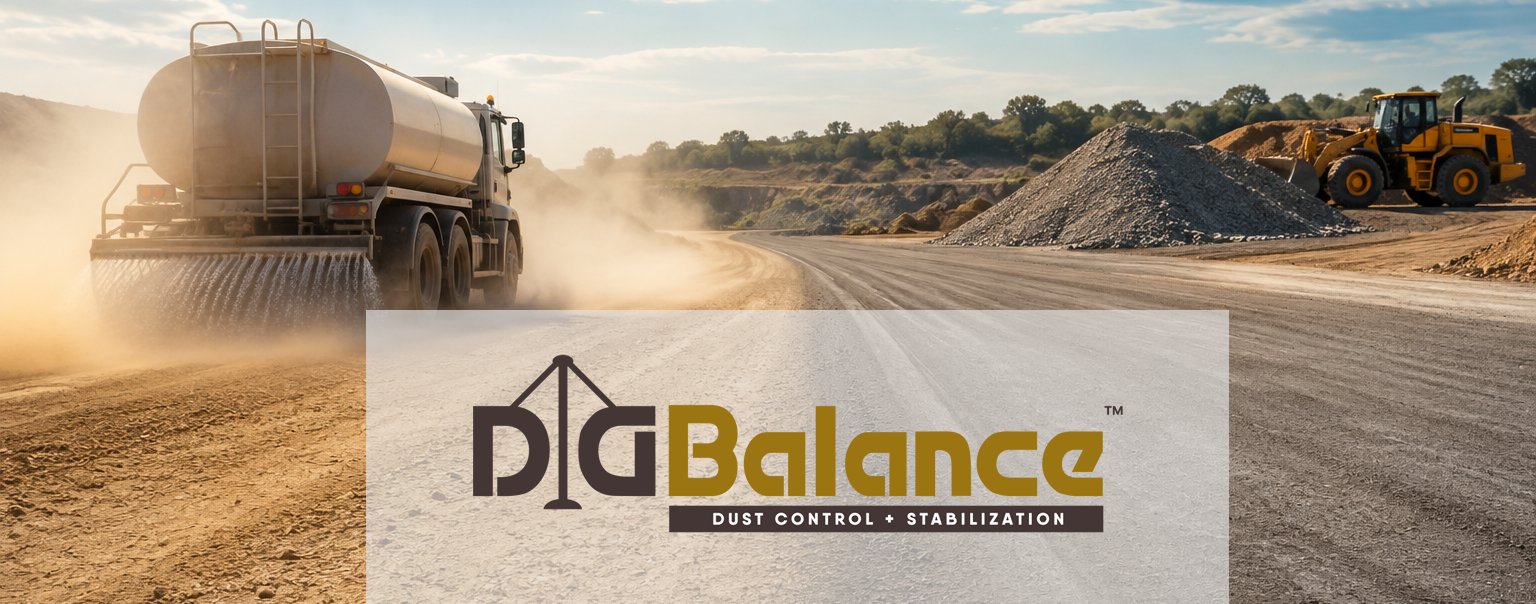
Water is still a common way to control dust on unpaved roads and work areas. It is readily available and easy to apply.
The problem is that it doesn’t work for very long.
Once the surface dries, traffic starts generating dust again and the water truck makes another pass. During hot and dry conditions, this may happen several times in the same day. Over the course of a project, the cost of the truck, driver, fuel, maintenance, water, and repeated applications can add up quickly.
At the other end of the spectrum are products designed for long-term soil and road stabilization. These can make sense for permanent roads or heavily trafficked surfaces, but they can also be more treatment than a temporary road or work area actually needs.
There is a fairly large gap between these two approaches. DG Balance™ was developed to fill that gap: an economical dust-control treatment that also provides some light, flexible stabilization of the surface.
Water Is Cheap. Watering Isn’t Cheap Dust Control.
One of the reasons water remains so common for dust control is that everyone understands it. Put water on a dusty road and the dust goes away.
But the cost of the water itself is only part of the equation.
Someone has to fill the truck, drive it, apply the water, and repeat the process when the road dries. The truck consumes fuel, requires maintenance, and is unavailable for other work while it is being used for dust control. At sites without a convenient water source, there is also the cost and logistics of getting the water where it is needed.
For a road that only needs occasional treatment, none of this may be a major concern. If the water truck is making repeated passes every day for weeks or months, however, it is worth looking at what that operation is actually costing.
This is where comparing treatments simply on cost per gallon can be misleading. The better comparison is the total cost of keeping the road under control for the duration of the project.
Sometimes You Just Need the Road to Perform Better
Dust problems and surface problems usually aren’t separate.
Traffic moves loose aggregate and fines around the road. As the aggregate breaks down, more fine material becomes available to create dust. Water temporarily suppresses those fines, but once the road dries, there is very little left to help hold the surface together.
A small amount of stabilization can make a meaningful difference.
That doesn’t mean the road needs to become hard or pavement-like. In many applications, the objective is simply to reduce loose material, provide some cohesion at the surface, and keep the road performing reasonably well under traffic.
DG Balance is designed around this idea. It provides dust control while also giving the treated material mild, flexible stabilization.
For a temporary construction road, industrial yard, or access road that may only be needed for a season or the duration of a project, that may be all the stabilization that is necessary.
A Step Between Water and Long-Term Stabilization
We don’t view DG Balance as a replacement for every watering program, and we don’t view it as a replacement for heavy-duty stabilization.
It sits between the two.
If inexpensive water is available, a water truck is already on site, and dust only needs to be controlled occasionally, water may still be the most practical choice.
If a road needs substantial structural improvement or long-term stabilization, a heavier stabilization treatment may make more sense.
DG Balance becomes particularly attractive when a site is spending significant time and money repeatedly watering a surface but doesn’t have the need or budget for a full stabilization program.
Instead of paying for the maximum possible performance, the customer is paying for the level of performance the project actually needs.
Where DG Balance Fits
We see this situation frequently on temporary construction and access roads, mine and quarry roads, industrial yards, laydown areas, gravel parking areas, utility projects, temporary haul roads, and other unpaved working surfaces.
These sites often have a similar requirement. They need to keep dust under control, they would benefit from a somewhat tighter and more stable surface, but they don’t necessarily need to build a permanent road.
Project duration matters too. There is little reason to design a treatment around years of service if the road will be removed or abandoned in six months.
In those situations, DG Balance can provide a practical balance of treatment cost, dust control, and surface improvement.
Look at the Cost Over the Life of the Project
A water truck can look inexpensive when viewed one application at a time.
The economics can look very different after adding up several applications per day, five or six days per week, over several months.
Every trip represents truck time, labor, fuel, maintenance, and water. If the surface dries and needs to be treated again, the same costs occur again.
DG Balance is intended to reduce that dependence on repeated watering while also providing some residual binding of the surface material. The exact performance and application frequency will depend on the soil or aggregate, traffic, weather, application rate, and other site conditions, which is why we prefer to evaluate the application rather than make a one-size-fits-all recommendation.
For many projects, the goal isn’t to eliminate every future application. It is simply to reduce how much time and money are being spent chasing dust with a water truck.
Finding the Right Level of Treatment
There is no reason to over-engineer a temporary road. There is also no reason to keep paying to control the same dust if a more persistent treatment makes better economic sense.
That is the niche DG Balance was designed to serve.
It is an economical dust-control option for sites that need more than water, along with some light stabilization, but don’t need the cost or performance of a heavy-duty stabilization program.
Global Environmental Solutions can review the surface material, traffic, size of the treatment area, project duration, and current watering program to determine whether DG Balance makes sense for a particular site.
If you are currently running water trucks regularly for dust control, contact GES. We can compare your existing watering program with a DG Balance treatment approach and determine whether there is an opportunity to reduce costs while improving surface performance.
Frequently Asked Questions
What is a more economical alternative to watering dirt and gravel roads?
For sites that require frequent watering, a longer-lasting dust-control treatment may reduce the overall cost of managing dust. DG Balance™ is designed as an economical step up from water, providing dust control along with light surface stabilization. The best choice depends on water availability, traffic, road material, climate, and how long the road needs to remain in service.
How can I reduce the cost of watering roads for dust control?
Start by looking beyond the cost of the water itself. Calculate the cost of the water truck, driver, fuel, maintenance, filling time, water sourcing, and the number of applications required each day. If repeated watering represents a significant operating expense, a longer-lasting dust suppressant such as DG Balance may be more economical over the life of the project.
Is there a dust-control product that also helps stabilize a gravel road?
Yes. Some dust-control treatments also provide binding or stabilization of the surface material. DG Balance is designed to provide dust suppression together with mild, flexible stabilization. It is intended for applications where improved surface performance is useful but heavy-duty stabilization isn’t necessary.
What is the best dust control for a temporary construction road?
There isn’t one treatment that is best for every construction road. Water can make sense for very short-term applications, while more substantial stabilization may be appropriate for heavily trafficked roads that will remain in service for years. For temporary or intermediate-duration roads that require regular dust control, DG Balance can provide an economical option between repeated watering and full stabilization.
Is chemical dust control cheaper than using a water truck?
It can be, particularly when a road has to be watered several times per day over an extended period. The appropriate comparison is not the price of water versus the price of a dust suppressant per gallon. It is the total cost of keeping the road under control, including equipment, labor, fuel, maintenance, water sourcing, application frequency, and treatment longevity.
What is the difference between dust suppression and road stabilization?
Dust suppression primarily addresses airborne particles generated from the road surface. Stabilization improves the cohesion or strength of the road material itself. Some treatments, including DG Balance, fall between these categories by providing effective dust control along with light stabilization of the treated surface.
How do I know if DG Balance is right for my road?
The main factors are the road material, traffic level, climate, treatment area, available water, current watering frequency, required service life, and desired level of stabilization. GES can review these conditions and compare DG Balance with watering or other dust-control and stabilization approaches.

 What on earth are we talking about?