

High-Performance Dust Control for Mining

mining dust control

Improving Haul Road Performance, Reducing Maintenance, and Lowering Operating Costs

Prepared by
Global Environmental Solutions (GES)

Executive Summary

Dust control is more than a housekeeping issue in modern mining operations, it is an operational, environmental, and economic challenge. Dust generated from haul roads, crusher areas, stockpiles, tailings facilities, and plant roads can reduce visibility, increase equipment wear, accelerate road deterioration, increase water consumption, and contribute to worker exposure to respirable dust.

While water trucks remain the most common dust suppression method, water alone provides only temporary control and often requires continuous reapplication. Increasingly, mining operations are evaluating engineered dust control technologies that not only suppress dust, but also stabilize road surfaces, reduce maintenance, conserve water, and improve overall operating efficiency.

This article examines where engineered dust control products perform best in mining operations, the operational benefits beyond dust suppression, and the engineering considerations that determine long-term success.

Why It Matters

In many surface mining operations, haul roads are the single largest source of fugitive dust. Improving road performance not only reduces airborne dust, but also lowers maintenance costs, conserves water, and improves overall mine productivity.

Why Dust Control Matters in Mining

Every ton of material hauled across an unpaved road generates fine dust particles. As truck traffic increases, these particles are displaced from the road surface, resulting in:

  • Reduced visibility
  • Increased safety risks
  • Loss of valuable road fines
  • Increased washboarding and rutting
  • More frequent road maintenance
  • Higher water consumption
  • Increased equipment wear

Dust is therefore both a safety issue and a road maintenance issue.

The most successful dust control programs focus not only on suppressing airborne dust, but also on preserving the road surface itself.

High-Value Mining Applications

Haul Roads

Mine haul roads are typically the largest source of fugitive dust within a mining operation.

Heavy truck traffic breaks down aggregate surfaces, causing fine particles to become airborne while simultaneously degrading road quality.

Properly selected dust control and stabilization products can:

  • Bind surface fines
  • Reduce dust generation
  • Improve surface durability
  • Reduce washboarding
  • Reduce pothole formation
  • Extend grading intervals

The result is a smoother road that requires less maintenance while improving truck productivity.

Plant Roads

Roads surrounding processing plants experience continuous traffic from loaders, service vehicles, and haul trucks.

Dust generated in these areas can affect:

  • Plant operations
  • Equipment reliability
  • Employee safety
  • Housekeeping requirements

Engineered dust control products help maintain cleaner, more durable road surfaces while reducing maintenance requirements.

Crusher Areas

Crusher facilities generate significant quantities of fine particulate matter.

Dust suppression around crushers helps improve:

  • Operator visibility
  • Equipment cleanliness
  • Maintenance requirements
  • Working conditions

Because these areas often experience concentrated traffic and repeated disturbance, stabilizing exposed aggregate surfaces can substantially reduce airborne dust.

Tailings Facilities

Tailings storage facilities frequently contain large exposed surfaces that become susceptible to wind erosion during dry periods.

Depending on site conditions, engineered dust control products may help stabilize exposed surfaces and reduce windblown dust while minimizing disturbance to the facility.

Each tailings facility should be evaluated individually based on material characteristics, moisture conditions, and operational requirements.

Stockpiles

Aggregate, overburden, and mineral stockpiles are another common source of fugitive dust.

Temporary treatments can help:

  • Reduce wind erosion
  • Preserve stored material
  • Improve housekeeping
  • Reduce environmental complaints

Applications should be selected based on expected storage duration and operational activity.

Underground Mines

Underground mining presents unique dust challenges where ventilation systems can transport airborne particles throughout active workings.

Engineered dust control products may help reduce dust generation on underground haul roads while lowering watering requirements and improving trafficability.

Beyond Dust Suppression

Successful mining operations increasingly evaluate dust control based on total operating cost rather than application cost alone.

Potential operational benefits include:

  • Reduced water truck usage
  • Lower grader operating hours
  • Improved road surface stability
  • Reduced aggregate replacement
  • Lower equipment maintenance
  • Improved tire life
  • Improved truck cycle times
  • Better visibility
  • Improved working conditions

In many cases, these secondary benefits provide as much value as dust suppression itself.

Engineering Considerations

No single dust control technology performs equally well under every mining condition.

Successful projects begin by evaluating:

  • Traffic volume
  • Vehicle weight
  • Aggregate gradation
  • Fine particle content
  • Climate
  • Rainfall frequency
  • Water availability
  • Freeze-thaw conditions
  • Road geometry
  • Maintenance practices

These factors determine both product selection and application rate.

Engineered Dust Control Compared with Water

Performance Factor Water Engineered Dust Control Products
Immediate Dust Suppression Excellent Excellent
Long-Term Dust Control Low High
Surface Stabilization None Excellent
Reduced Grading No Yes
Reduced Water Consumption No Yes
Preservation of Road Fines No Yes
Maintenance Interval Short Extended

Water remains an important dust suppression tool, particularly for short-term control.

Engineered dust control products provide the additional benefit of improving the structural performance of the road surface while reducing long-term maintenance requirements.

Depending on site conditions, DustLess® may be preferred where long-term dust suppression is the primary objective, while DirtGlue® may be selected where both dust control and aggregate stabilization are desired.

Selecting the Right GES Solution

Every mining operation is different.

Traffic loading, aggregate characteristics, climate, and maintenance objectives all influence product selection.

DustLess® is designed primarily for long-term dust suppression while helping reduce watering frequency and improve operational efficiency.

DirtGlue® combines dust suppression with aggregate stabilization, helping preserve road fines, reduce grading frequency, and improve long-term haul road performance.

Successful applications begin with a site-specific engineering evaluation to determine the most appropriate solution.

Looking Ahead

Mining companies continue to seek practical methods for improving operational efficiency while reducing maintenance costs, water consumption, and environmental impacts.

Engineered dust control should not be viewed simply as a replacement for watering roads. Instead, it represents an engineering approach to improving haul road performance, preserving aggregate, reducing maintenance, and lowering the total cost of road ownership.

As operations place greater emphasis on sustainability, productivity, and worker safety, integrated road stabilization strategies will continue to play an increasingly important role in modern mine management.

Dust control should no longer be viewed solely as an environmental requirement. When properly engineered, it becomes an operational improvement strategy that reduces maintenance, conserves water, improves productivity, and extends the service life of mine infrastructure.

Free Preliminary Mining Road Assessment

Every mine is different.

Road geometry, aggregate quality, traffic loading, climate, and maintenance practices all influence dust generation and surface performance.

Global Environmental Solutions (GES) provides free preliminary engineering evaluations for mining operations considering improved dust control or haul road stabilization.

A preliminary assessment may include:

  • Estimated application rate
  • Expected dust reduction
  • Surface stabilization opportunities
  • Potential maintenance savings
  • Water use reduction
  • Preliminary product recommendations

To learn more or request a free preliminary mining road assessment, contact the GES team here.
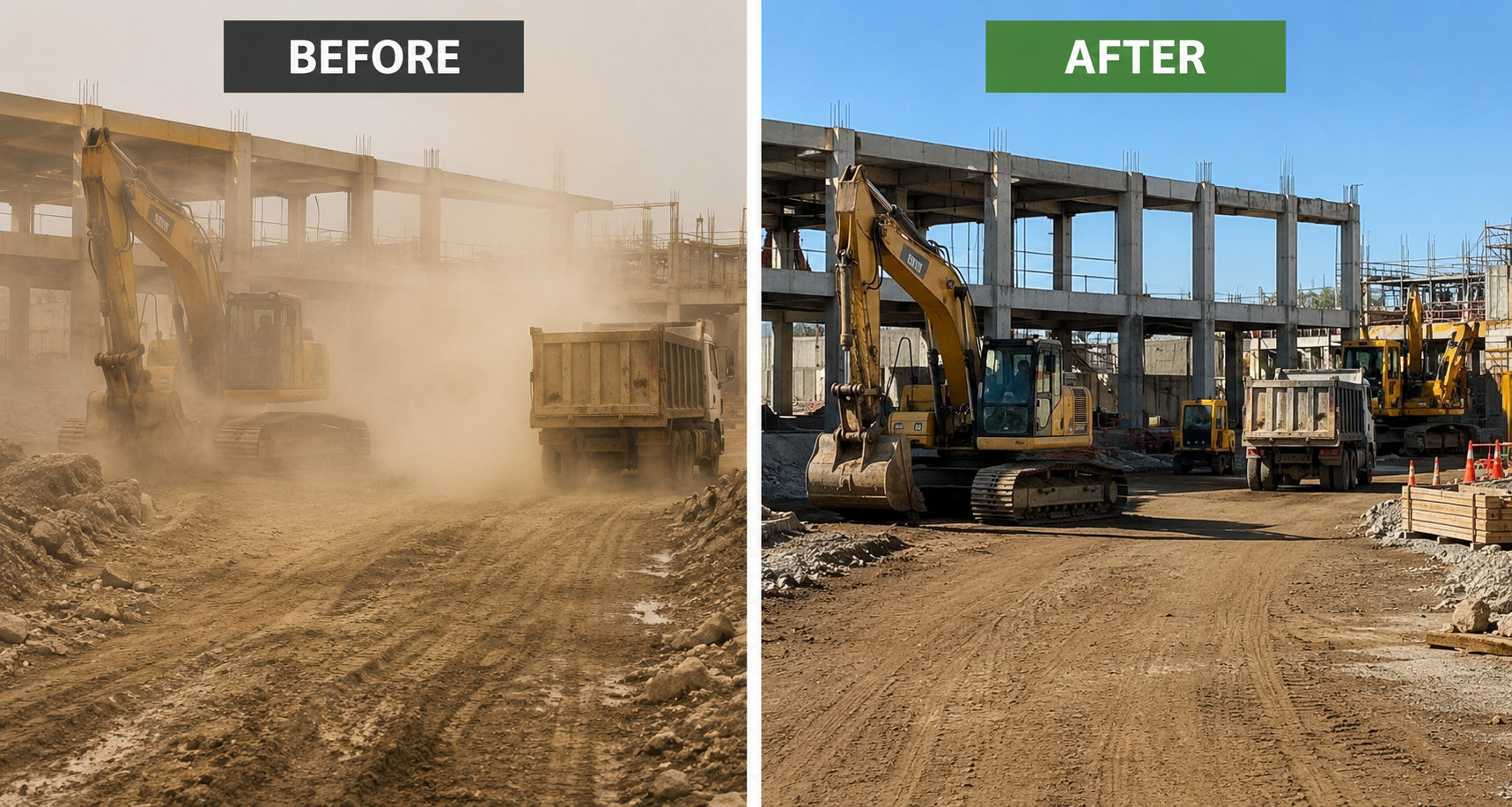
Long-Term Dust Control is a Water Conservation Strategy: Saving Millions of Gallons While Reducing Costs

Dust Control

For decades, water has been the most commonly used dust suppressant across construction sites, mines, aggregate operations, solar farms, industrial facilities, and municipal projects. It is readily available, relatively inexpensive on a per-gallon basis, and simple to apply. However, water also presents one significant limitation, it evaporates.

In many environments, water applied for dust control may provide only short-term performance before additional applications become necessary. The result is that some projects consume millions of gallons of water annually simply maintaining acceptable dust conditions.

Today, long-term dust control technologies are changing how owners and operators approach water management. Rather than continually replacing moisture lost to evaporation, engineered dust suppressants can substantially reduce water consumption while simultaneously lowering labor requirements, reducing equipment utilization, and improving operational efficiency.

Increasingly, long-term dust control is becoming more than an operational expense, it is becoming a water conservation strategy.

The Hidden Cost of Water-Based Dust Control

Water is often viewed as the least expensive dust control option because the material itself is inexpensive or readily available. However, the true cost of water-based dust suppression extends well beyond the cost of the water itself.

Daily or multiple daily applications may require:

  • Water trucks and associated equipment
  • Equipment operators
  • Fuel consumption
  • Vehicle maintenance and repairs
  • Tires and replacement parts
  • Water sourcing and pumping costs
  • Increased road maintenance requirements
  • Additional traffic interruptions during application
  • Equipment rentals or capital expenditures
  • Labor costs associated with repeated applications

Under warm, dry, or windy conditions, water may evaporate quickly enough to necessitate multiple applications throughout the day. In these situations, operators are often paying repeatedly to replace moisture that may only provide temporary dust suppression benefits.

The cumulative costs can become significant over the life of a project.

How Much Water Do Dust Control Operations Use?

Actual water consumption varies considerably depending upon climate conditions, traffic volumes, application frequency, and project size. Even relatively modest operations, however, may consume substantial volumes of water over the course of a year.

Consider a project utilizing a single 4,000-gallon water truck making ten applications per day.

  • 40,000 gallons per day
  • 200 operating days annually
  • 8 million gallons of water annually

Larger operations utilizing multiple water trucks may consume tens of millions of gallons of water each year for dust control purposes alone.

While water will remain an appropriate solution for some applications, many projects benefit from evaluating the total cost of ownership associated with continual water applications rather than considering water costs in isolation.

Why Long-Term Dust Control Technologies Use Less Water

Long-term dust suppressants approach dust control differently than water-based applications.

Rather than relying solely upon temporary moisture addition, long-term dust control technologies are designed to improve particle retention to the surface.

The potential benefits include:

  • Reduced application frequency
  • Lower annual water consumption
  • Reduced labor requirements
  • Lower fuel usage
  • Reduced water truck utilization
  • Improved operational efficiency
  • Reduced traffic interruptions associated with dust control activities

Because every project is unique, the appropriate dust control technology will depend upon factors including traffic volumes, surface materials, environmental conditions, performance requirements, and budget considerations.

For many applications, reducing water consumption becomes both an environmental and economic benefit.

Dust Control is Becoming a Water Conservation Strategy

Historically, dust control has been viewed primarily as an operational requirement. Increasingly, however, owners and operators are incorporating water conservation objectives into project planning and operations.

Water conservation initiatives are becoming increasingly important across:

  • Construction projects
  • Solar energy developments
  • Mining operations
  • Aggregate facilities
  • Industrial sites
  • Municipal infrastructure projects
  • Landfills and waste management facilities
  • Transportation corridors and temporary access roads

Reducing annual water consumption can provide meaningful operational benefits regardless of whether a project’s primary objective is sustainability, cost reduction, or improved dust control performance.

For many facilities, reducing water consumption also means reducing labor requirements, equipment utilization, and maintenance costs simultaneously.

Long-term dust control technologies frequently allow owners and operators to pursue all of these objectives together.

Water Trucks vs. Long-Term Dust Control Technologies

When evaluating dust control strategies, project teams should consider more than simply material costs. Actual performance will vary based upon product selection, application rates, site conditions, and project objectives. The appropriate dust control strategy should always consider the total cost of ownership over the anticipated life of the project.

Parameter Water Trucks Long-Term Dust Control
Water Consumption High Low
Application Frequency Daily Less Frequent
Labor Requirements High Low
Fuel Consumption High Low
Equipment Utilization High Low
Operational Interruptions High Low
Performance Duration Short-Term Longer Lasting
Water Conservation Benefits Low High

Applications Where Water Conservation Matters

Solar Farms

Large solar developments frequently encompass hundreds or thousands of acres requiring ongoing dust management during both construction and operations. Reducing water truck utilization can provide meaningful labor, water, and operational savings over the life of the project.

Mining Operations

Mining facilities often operate continuously while managing extensive haul roads and high traffic volumes. Even modest reductions in water consumption can represent substantial annual savings at large sites.

Aggregate Facilities

Quarries and aggregate operations routinely balance dust control requirements with production objectives. Long-term dust suppressants may reduce application frequency while helping maintain safe and efficient operations.

Construction Projects

Temporary access roads, staging areas, and infrastructure projects frequently require repeated dust control applications. Reducing water usage may provide both economic and logistical benefits for contractors.

Municipal and Industrial Facilities

Municipalities and industrial operators are increasingly evaluating dust control strategies through the lens of operational efficiency and resource management. Long-term dust control technologies may support both objectives simultaneously.

Choosing the Right Long-Term Dust Control Solution

No single dust control technology is appropriate for every application.

Some projects benefit from DustLess® or DirtGlue® Balance suppressants designed for routine maintenance applications, while others require DirtGlue® for longer-term soil stabilization withstanding significant traffic or environmental exposure.

Factors influencing product selection include:

  • Surface material characteristics
  • Traffic volumes and vehicle types
  • Climate and rainfall conditions
  • Project duration
  • Water availability
  • Budget considerations
  • Environmental and operational requirements
  • Desired maintenance intervals

Proper product selection begins with understanding the operational objectives of the project rather than simply identifying a dust control product.

How Much Water Could Your Project Save?

Every project is different. Actual water savings will depend upon:

  • Project size
  • Water truck utilization
  • Climate conditions
  • Traffic volumes
  • Surface characteristics
  • Application frequency requirements
  • Desired dust control performance

Projects transitioning from frequent water applications to appropriately selected long-term dust control technologies frequently experience substantial reductions in water consumption while also realizing operational efficiencies in labor, fuel usage, and equipment utilization.

Evaluating these opportunities requires considering the complete operational picture rather than simply comparing material costs.

Water Consumption Comparison with Long-Term Dust Suppression
Water Use Long-Term Dust Control
A Single 4,000-gallon water truck making 4 applications per day may use:

  • 16,000 gallons per day
  • (200 operating days)
A Single long-term dust control applications may utilize and provide:

  • Single Application
  • Dust Control lasting 3-12+ months
Total Water Use Annually 

3,200,000 gallons

Total Water Use with DustLess® 

0 Gallons

DustLess® could save 3,200,000 gallons annually in this example application*

*Actual water savings will depend upon project size, traffic volumes, climate conditions, application rates, and maintenance requirements.

Partnering With GES for Long-Term Dust Control

GES works directly with owners, contractors, engineers, and operators to evaluate long-term dust control strategies across a wide range of applications.

Depending upon project objectives, our team can help evaluate:

  • Annual water consumption estimates
  • Water truck utilization requirements
  • Dust control operating costs
  • Long-term maintenance requirements
  • Product selection considerations
  • Water conservation opportunities
  • Preliminary application and budget estimates

Long-term dust control is no longer simply about controlling dust. For many projects, it has become an opportunity to conserve water, improve operational efficiency, and reduce the total cost of maintaining site conditions over time.

If your project is utilizing daily or repeated water applications for dust control, contact the GES team for a complimentary project evaluation and water conservation assessment.

Dust Control Costs Explained: Why Water Trucks Cost More Than You Think

For many industrial facilities, dust control is managed reactively, when there are complaints, water trucks are deployed as the default solution. While water appears inexpensive on the surface, a closer look reveals that it is often the highest-cost dust control strategy over time. Understanding the true economics of dust suppression helps operators reduce operating expenses, improve site safety, and maintain regulatory compliance.

The Hidden Costs of Water Truck Dust Control

Water trucks are widely used because they are simple and familiar. However, water provides only short-term dust suppression and evaporates quickly, especially in hot, dry, or windy conditions, often times lasting less than just a few hours. This leads to frequent reapplication, sometimes multiple times per day, sometimes near continuous water truck operation.

Operating water trucks have common hidden costs which include:

  • Labor and operator hours
  • Fuel consumption and equipment wear
  • Downtime during repeated watering cycles
  • Inconsistent dust control between applications

When evaluated on a cost-per-acre, per-month basis, water trucks are often among the most expensive dust control options available.

Long-Term Dust Control with DustLess® and DirtGlue®

Long-term dust control solutions such as DustLess® and DirtGlue® are engineered to address dust at its source by binding surface particles together and stabilizing the treated area. Rather than relying on moisture alone, these products form a durable matrix that resists wind, traffic, and weather.

DustLess® is designed for heavily traveled areas within industrial yards, haul roads, mining facilities, and material handling areas where consistent dust suppression is required with minimal reapplication. DirtGlue® provides long-term surface stabilization for areas that experience minimal traffic but are subject to water or wind erosion, or recurring dust issues.

Key advantages of DustLess® and DirtGlue® include:

  • Long-lasting dust suppression measured in months or years, not days
  • Fewer applications means real cost savings
  • Reduced labor, fuel, and equipment costs
  • Improved surface durability and site safety
  • Predictable performance across varying weather conditions

Cost Comparison: Short-Term vs Long-Term Dust Control

While long-term dust control solutions require a higher upfront investment, most industrial sites find that actual dust control costs are reduced significantly once frequent watering and reapplication cycles are eliminated.

Facilities using DustLess® and DirtGlue® often report:

  • Lower total cost of dust control.
  • Reduced operational disruptions
  • Fewer dust complaints and compliance concerns
  • Improved visibility

Choosing the Right Dust Control Strategy

Water trucks may be appropriate for short-term or emergency applications, but they are rarely the most economical solution for permanent industrial operations. For facilities seeking reliable, long-term dust control with measurable cost savings, long-term solutions such as DustLess® and DirtGlue® provide a clear advantage.

A site-specific evaluation is the most effective way to determine the optimal dust control approach and quantify potential cost savings, contact us today to learn more how DustLess® and DirtGlue® can offer real cost savings for dust control.


Smarter Dust Control for Heavy Industrial Yards

Dust Control for Heavy Industrial Yards

Industrial dust control is a daily challenge across ports, precast concrete plants, waste transfer stations, recycling facilities, quarries, foundries, and pipe yards. Every truck that rolls through these sites stirs up a storm of fine particulate dust that lingers in the air, coating machinery, equipment, and nearby buildings. It’s more than an eyesore, it can lead to air quality complaints, reduced visibility, and costly maintenance.

With a single application of DustLess®, the dust stops, not for a few hours, but for months. This industrial-grade dust suppressant creates a clean, stable surface that resists heavy traffic and harsh weather. The result is a noticeable transformation; a yard that feels cleaner, safer, and dust-free.

DirtGlue® and DustLess® are industry proven, long-lasting dust control solutions engineered to perform. When used at industrial facilities, DirtGlue® and DustLess® prevent airborne dust at the source, saving water, labor, and operational costs.

Facilities using DirtGlue® and DustLess® report:

  • Up to 95% Reduction in airborne dust
  • Over 90% Less water for dust control
  • Fewer complaints and compliance issues
  • Improved visibility and cleaner site appearance

Whether you manage a port, precast yard, foundry, or industrial facility, DirtGlue® and DustLess® help you stay compliant with air quality regulations, protect workers, and operate more efficiently, all while supporting your sustainability goals.

Replace Labor-Intensive Tarps with DirtGlue® for Material Stockpile Sealing

DirtGlue

A Better Way to Seal Stockpiles: The Story of Bauxite and DirtGlue®
At the heart of the deep south, a mountain bauxite sat exposed. The ore, raw source of aluminum metal, waited in massive stockpiles, destined for smelters. But with every passing storm cloud, an old problem returned: rain. For stockpiled bauxite, rain is no minor nuisance. Absorbed water drives up moisture content, triggering processing issues, higher transportation costs, and smelting delays. Industry standards reject ore loads above 17% moisture. Keeping the pile dry meant a constant battle, labor crews dragging heavy tarps, old truck tires were used to secure wind-flapped edges, crews worked to patch tears after every storm.

Global Environmental Solutions (GES), lead the deployment of DirtGlue®, a polymer-based surface sealant, on exposed bauxite stockpiles. Applied easily with a hydro-seeder, DirtGlue® cured to form a flexible, water-resistant crust, locking moisture out. The early results were striking: DirtGlue® not only reduced water uptake, it also eliminated the daily tarp struggle, cutting labor needs and costs. Additionally, the DirtGlue® seal was easily broken up with excavation equipment and additional material processing.

Technology Spotlight: Why DirtGlue® Outperforms Traditional Tarps
In industries as varied as aggregates, metals, and road maintenance, stockpile protection is a constant operational headache. Whether you’re storing:

  • Road salt
  • Gypsum
  • Ferrosilicon
  • Sand
  • Bauxite
  • Coal fines
  • Coke Fines
  • Aggregates
  • Cementitious Materials
  • Other water sensitive or dust prone materials

Using traditional tarps are a clumsy solution as they are:

  • Labor-intensive to deploy
  • Prone to wind damage and tearing
  • Require constant adjustment and repairs
  • Difficult to manage on large or irregular piles
  • Unsafe in poor weather conditions

DirtGlue® changes the game.
This eco-friendly, water-based polymer is applied directly to the stockpile surface using a standard hydroseeder or spray equipment. Once cured, it forms a durable, breathable crust that:

  • Seals out rainwater, reducing moisture absorption
  • Resists wind and weather, with no need for re-tightening
  • Eliminates tarp labor, saving both time and money
  • Improves worker safety, with no climbing or tarp handling required
  • Eliminates wind blown dust, keeping material onsite

Proven Results in Real-World Applications
Bauxite stockpiles, and other materials, have shown incredible results using DirtGlue® instead of tarps. The treated piles resisted rain penetration far more effectively than uncovered material and with none of the operational headaches of tarps.
Similar success has been achieved on stockpiles of:

  • Road salt for DOT and municipal yards (preventing clumping and runoff)
  • Ferrosilicon and other metal ores (protecting product quality)
  • Gypsum (minimizing handling losses)
  • Fine sands and aggregates (maintaining consistency for ready-mix applications)

Fast, Simple Application
DirtGlue® requires no exotic equipment. Any crew equipped with a hydroseeder or standard spray rig can apply the product. One treatment can provide several months to a few years of protection, depending on climate and stockpile turnover.

The Smart Replacement for Tarps
Across industries, savvy operators are moving away from tarp-based stockpile protection. DirtGlue® offers a modern, efficient, and cost-saving alternative keeping valuable materials dry, minimizing environmental impacts, and reducing operational hassle.
If your operation is still fighting with tarps, it’s time for an upgrade. Contact Global Environmental Solutions today to learn how DirtGlue® can simplify your stockpile management and cut costs from day one.