

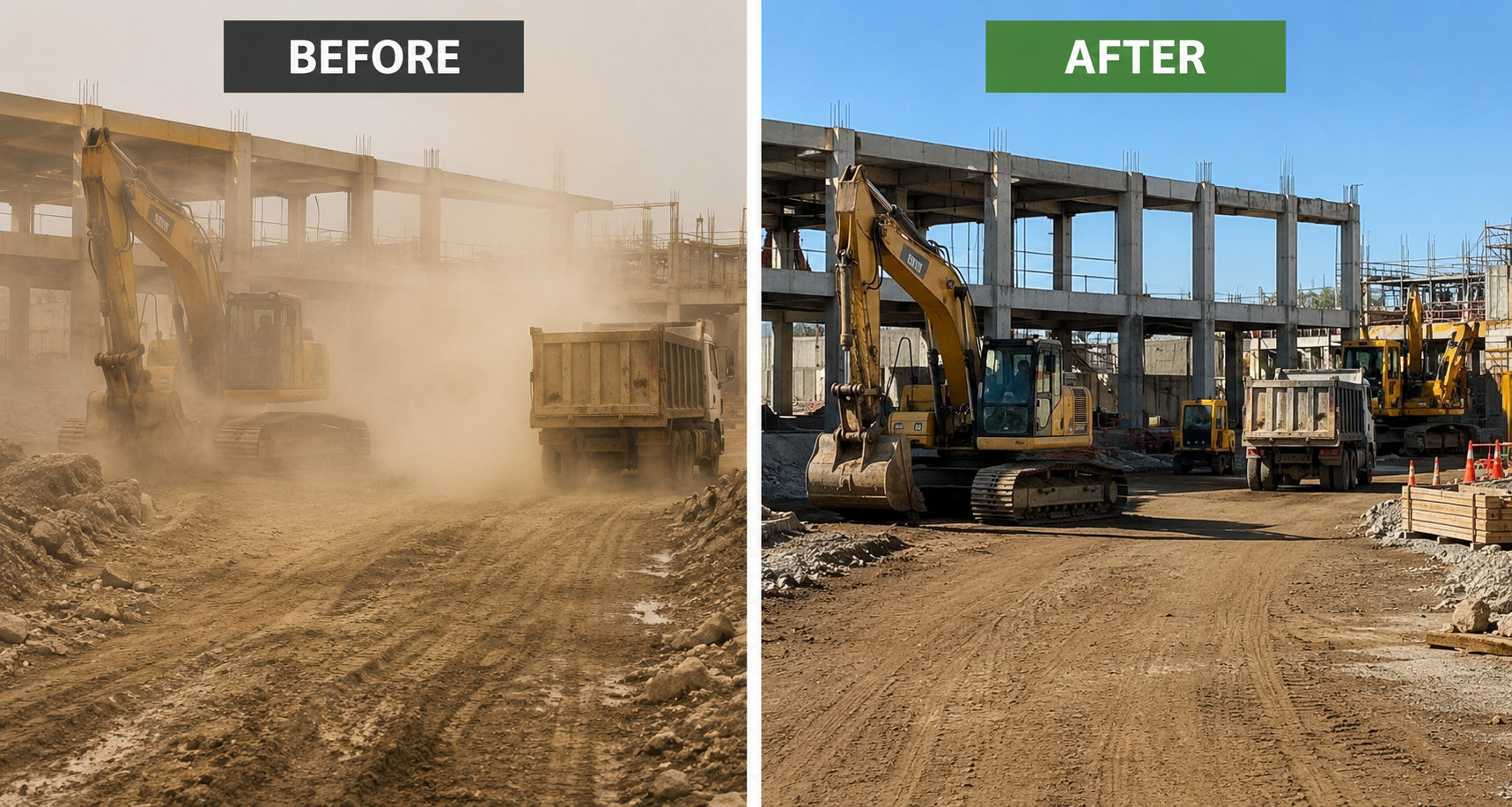
For decades, water has been the most commonly used dust suppressant across construction sites, mines, aggregate operations, solar farms, industrial facilities, and municipal projects. It is readily available, relatively inexpensive on a per-gallon basis, and simple to apply. However, water also presents one significant limitation, it evaporates.
In many environments, water applied for dust control may provide only short-term performance before additional applications become necessary. The result is that some projects consume millions of gallons of water annually simply maintaining acceptable dust conditions.
Today, long-term dust control technologies are changing how owners and operators approach water management. Rather than continually replacing moisture lost to evaporation, engineered dust suppressants can substantially reduce water consumption while simultaneously lowering labor requirements, reducing equipment utilization, and improving operational efficiency.
Increasingly, long-term dust control is becoming more than an operational expense, it is becoming a water conservation strategy.
The Hidden Cost of Water-Based Dust Control
Water is often viewed as the least expensive dust control option because the material itself is inexpensive or readily available. However, the true cost of water-based dust suppression extends well beyond the cost of the water itself.
Daily or multiple daily applications may require:
- Water trucks and associated equipment
- Equipment operators
- Fuel consumption
- Vehicle maintenance and repairs
- Tires and replacement parts
- Water sourcing and pumping costs
- Increased road maintenance requirements
- Additional traffic interruptions during application
- Equipment rentals or capital expenditures
- Labor costs associated with repeated applications
Under warm, dry, or windy conditions, water may evaporate quickly enough to necessitate multiple applications throughout the day. In these situations, operators are often paying repeatedly to replace moisture that may only provide temporary dust suppression benefits.
The cumulative costs can become significant over the life of a project.
How Much Water Do Dust Control Operations Use?
Actual water consumption varies considerably depending upon climate conditions, traffic volumes, application frequency, and project size. Even relatively modest operations, however, may consume substantial volumes of water over the course of a year.
Consider a project utilizing a single 4,000-gallon water truck making ten applications per day.
- 40,000 gallons per day
- 200 operating days annually
- 8 million gallons of water annually
Larger operations utilizing multiple water trucks may consume tens of millions of gallons of water each year for dust control purposes alone.
While water will remain an appropriate solution for some applications, many projects benefit from evaluating the total cost of ownership associated with continual water applications rather than considering water costs in isolation.
Why Long-Term Dust Control Technologies Use Less Water
Long-term dust suppressants approach dust control differently than water-based applications.
Rather than relying solely upon temporary moisture addition, long-term dust control technologies are designed to improve particle retention to the surface.
The potential benefits include:
- Reduced application frequency
- Lower annual water consumption
- Reduced labor requirements
- Lower fuel usage
- Reduced water truck utilization
- Improved operational efficiency
- Reduced traffic interruptions associated with dust control activities
Because every project is unique, the appropriate dust control technology will depend upon factors including traffic volumes, surface materials, environmental conditions, performance requirements, and budget considerations.
For many applications, reducing water consumption becomes both an environmental and economic benefit.
Dust Control is Becoming a Water Conservation Strategy
Historically, dust control has been viewed primarily as an operational requirement. Increasingly, however, owners and operators are incorporating water conservation objectives into project planning and operations.
Water conservation initiatives are becoming increasingly important across:
- Construction projects
- Solar energy developments
- Mining operations
- Aggregate facilities
- Industrial sites
- Municipal infrastructure projects
- Landfills and waste management facilities
- Transportation corridors and temporary access roads
Reducing annual water consumption can provide meaningful operational benefits regardless of whether a project’s primary objective is sustainability, cost reduction, or improved dust control performance.
For many facilities, reducing water consumption also means reducing labor requirements, equipment utilization, and maintenance costs simultaneously.
Long-term dust control technologies frequently allow owners and operators to pursue all of these objectives together.
Water Trucks vs. Long-Term Dust Control Technologies
When evaluating dust control strategies, project teams should consider more than simply material costs. Actual performance will vary based upon product selection, application rates, site conditions, and project objectives. The appropriate dust control strategy should always consider the total cost of ownership over the anticipated life of the project.
| Parameter | Water Trucks | Long-Term Dust Control |
| Water Consumption | High | Low |
| Application Frequency | Daily | Less Frequent |
| Labor Requirements | High | Low |
| Fuel Consumption | High | Low |
| Equipment Utilization | High | Low |
| Operational Interruptions | High | Low |
| Performance Duration | Short-Term | Longer Lasting |
| Water Conservation Benefits | Low | High |
Applications Where Water Conservation Matters
Solar Farms
Large solar developments frequently encompass hundreds or thousands of acres requiring ongoing dust management during both construction and operations. Reducing water truck utilization can provide meaningful labor, water, and operational savings over the life of the project.
Mining Operations
Mining facilities often operate continuously while managing extensive haul roads and high traffic volumes. Even modest reductions in water consumption can represent substantial annual savings at large sites.
Aggregate Facilities
Quarries and aggregate operations routinely balance dust control requirements with production objectives. Long-term dust suppressants may reduce application frequency while helping maintain safe and efficient operations.
Construction Projects
Temporary access roads, staging areas, and infrastructure projects frequently require repeated dust control applications. Reducing water usage may provide both economic and logistical benefits for contractors.
Municipal and Industrial Facilities
Municipalities and industrial operators are increasingly evaluating dust control strategies through the lens of operational efficiency and resource management. Long-term dust control technologies may support both objectives simultaneously.
Choosing the Right Long-Term Dust Control Solution
No single dust control technology is appropriate for every application.
Some projects benefit from DustLess® or DirtGlue® Balance suppressants designed for routine maintenance applications, while others require DirtGlue® for longer-term soil stabilization withstanding significant traffic or environmental exposure.
Factors influencing product selection include:
- Surface material characteristics
- Traffic volumes and vehicle types
- Climate and rainfall conditions
- Project duration
- Water availability
- Budget considerations
- Environmental and operational requirements
- Desired maintenance intervals
Proper product selection begins with understanding the operational objectives of the project rather than simply identifying a dust control product.
How Much Water Could Your Project Save?
Every project is different. Actual water savings will depend upon:
- Project size
- Water truck utilization
- Climate conditions
- Traffic volumes
- Surface characteristics
- Application frequency requirements
- Desired dust control performance
Projects transitioning from frequent water applications to appropriately selected long-term dust control technologies frequently experience substantial reductions in water consumption while also realizing operational efficiencies in labor, fuel usage, and equipment utilization.
Evaluating these opportunities requires considering the complete operational picture rather than simply comparing material costs.
| Water Consumption Comparison with Long-Term Dust Suppression | |
| Water Use | Long-Term Dust Control |
A Single 4,000-gallon water truck making 4 applications per day may use:
|
A Single long-term dust control applications may utilize and provide:
|
| Total Water Use Annually
3,200,000 gallons |
Total Water Use with DustLess®
0 Gallons |
| DustLess® could save 3,200,000 gallons annually in this example application* | |
*Actual water savings will depend upon project size, traffic volumes, climate conditions, application rates, and maintenance requirements.
Partnering With GES for Long-Term Dust Control
GES works directly with owners, contractors, engineers, and operators to evaluate long-term dust control strategies across a wide range of applications.
Depending upon project objectives, our team can help evaluate:
- Annual water consumption estimates
- Water truck utilization requirements
- Dust control operating costs
- Long-term maintenance requirements
- Product selection considerations
- Water conservation opportunities
- Preliminary application and budget estimates
Long-term dust control is no longer simply about controlling dust. For many projects, it has become an opportunity to conserve water, improve operational efficiency, and reduce the total cost of maintaining site conditions over time.
If your project is utilizing daily or repeated water applications for dust control, contact the GES team for a complimentary project evaluation and water conservation assessment.