

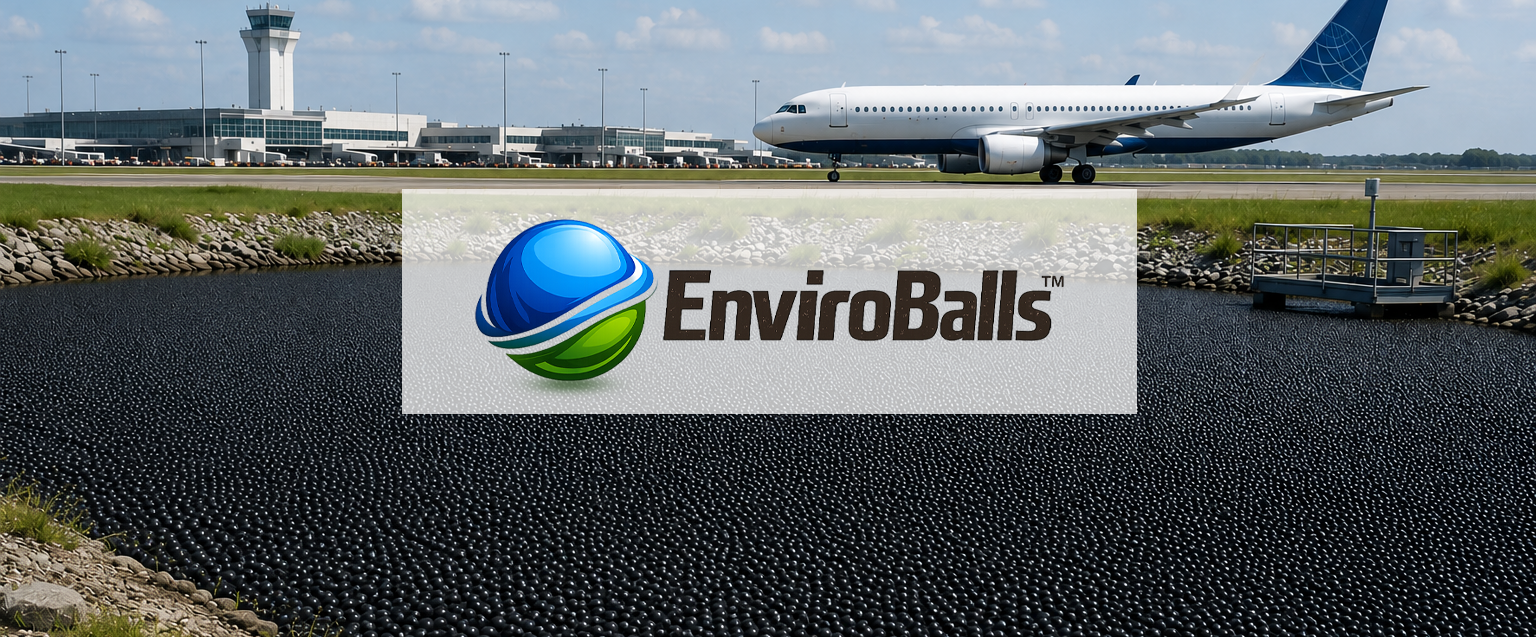
Floating Surface Covers for Airport Stormwater Ponds, Detention Basins, and Open Water Features
A technical overview for airport operations managers, wildlife hazard coordinators, environmental engineers, and stormwater professionals evaluating floating surface covers (“bird balls” or “shade balls”) for airport water infrastructure.
What Are Bird Balls?
Bird balls, also called floating surface covers, shade balls, or floating pond balls, are modular floating HDPE spheres deployed on open water surfaces such as stormwater detention basins, retention ponds, reservoirs, and industrial water systems.
Airport operators and environmental engineers may evaluate bird balls as one component of broader airport wildlife hazard management and bird strike risk reduction strategies. Floating surface covers are designed to reduce visible open-water surface area, which may help reduce the attractiveness of certain water bodies to waterfowl and gull species associated with aircraft wildlife strike risk.
In addition to wildlife hazard reduction objectives, floating surface covers may also provide secondary operational benefits, including evaporation reduction and reduced sunlight penetration into water bodies.
Why Open Water Is a Wildlife Hazard Concern at Airports
Open water located on or near airport property can attract birds, including waterfowl, gulls, wading birds, and migratory species. Stormwater detention ponds, retention basins, drainage channels, wetlands, and temporary standing water areas may create feeding, loafing, or resting habitat near aircraft operational areas.
According to the FAA National Wildlife Strike Database, more than 19,600 wildlife strikes were reported at U.S. airports during 2023, and over 22,300 in 2024. The annual cost of wildlife strikes to the US Civil Aviation industry estimated to be over 74,000 hours of aircraft downtime and $473 million in direct or other monetary losses, in 2024 alone1. FAA wildlife strike data also indicates that waterfowl species account for a disproportionately high percentage of damaging strike events relative to their percentage of total reported wildlife strikes.
Because of these risks, airport wildlife hazard management programs frequently evaluate methods intended to reduce wildlife attractants associated with airfield stormwater infrastructure and nearby water bodies.
FAA Guidance on Water Bodies Near Airports
FAA Advisory Circular (AC) 150/5200-33C, Hazardous Wildlife Attractants On or Near Airports, discusses wildlife attractants associated with airport operations, including open water features and stormwater infrastructure.
For airports serving turbine-powered aircraft, FAA guidance recommends maintaining separation distances between certain wildlife attractants and airport operational areas. Where water bodies cannot reasonably be eliminated or relocated, airport operators may evaluate operational and engineering measures intended to reduce wildlife attraction associated with open water conditions. Specific to stormwater, it is detailed in the advisory circular that physical barriers, such as bird balls, are mentioned as one method of wildlife deterrence for both new and existing stormwater facilities.
Airports should evaluate all wildlife hazard mitigation measures in coordination with qualified wildlife hazard management professionals, airport operations personnel, and applicable FAA guidance documents.
How Bird Balls May Reduce Wildlife Attraction
Bird balls work by covering a substantial portion of the visible water surface. Reducing visible open-water area may reduce the visual characteristics that attract certain bird species to ponds and detention basins.
Unlike fixed overhead systems, floating surface covers rise and fall with changing water levels; adapt to stormwater fluctuations; require minimal structural infrastructure; may allow continued access to pumps and basin structures; and can be deployed on irregular basin geometries.
Because floating sphere systems are passive and modular, airport operators may evaluate them for both temporary and long-term stormwater management applications.
Why Airports Evaluate Bird Balls
Airport operations teams, stormwater engineers, and wildlife hazard coordinators may evaluate bird balls because floating surface covers can:
- Reduce visible open-water surface area
- Function as passive wildlife hazard reduction systems
- Adapt to fluctuating stormwater levels
- Avoid large overhead support structures
- Require minimal fixed infrastructure
- Be deployed on existing detention basins
- Support broader airport wildlife hazard management strategies
Bird balls are often evaluated alongside other airport bird deterrent and wildlife hazard management measures, including habitat modification, vegetation management, and stormwater BMPs.
Bird Balls vs. Overhead Netting for Airport Ponds
Airport engineers and wildlife hazard managers commonly compare floating pond covers (“bird balls”) with overhead pond netting systems when evaluating airport stormwater wildlife mitigation strategies.
| Engineering Factor | Bird Balls / Floating Surface Covers | Overhead Netting |
| Primary mechanism | Reduces visible open-water area | Physical barrier above water |
| Water level adaptation | Self-adjusting with water elevation | Fixed installation geometry |
| Structural support requirements | Minimal in many applications | Poles/cable systems typically required |
| Access to basin infrastructure | Modular access around equipment | Access openings or repairs may be required |
| Suitability for irregular basins | Adaptable to many basin layouts | Site-specific structural design required |
| Sunlight reduction | Can reduce sunlight penetration | Limited shading effect |
| Maintenance considerations | Individual spheres replaceable | Net repair/replacement may be required |
The suitability of bird balls versus pond netting depends on site-specific engineering, wildlife pressure, maintenance priorities, and airport operational requirements.
Common Airport Applications for Bird Balls
Airport operators may evaluate floating surface covers for the following use cases.
Airport Stormwater Detention Basins
Stormwater detention ponds located within airport operational areas or wildlife hazard separation distances.
Airport Retention Ponds
Permanent retention ponds associated with airport drainage systems and environmental compliance infrastructure.
Fire Suppression Water Reservoirs
Open emergency water storage systems located near airport operational areas.
Drainage Channels and Ponding Areas
Localized standing-water areas within airport drainage systems.
Off-Airport Water Bodies Near Airports
Municipal ponds, industrial basins, and stormwater systems located within FAA wildlife hazard separation distances.
Temporary Construction Water Basins
Temporary stormwater management infrastructure associated with airport construction projects.
Engineering Characteristics of Floating Surface Covers
Typical floating surface cover systems (“bird balls” or “shade balls”) utilize UV-stabilized HDPE spheres designed for long-term outdoor exposure.
Typical Engineering Characteristics
- UV-stabilized HDPE construction
- Modular floating sphere design
- Passive deployment
- Adaptable to fluctuating water elevations
- Compatible with any stormwater basin geometries
- Minimal permanent infrastructure requirements
- Replaceable modular components
EnviroBalls™ floating surface covers are manufactured in the United States for stormwater, industrial, and water surface management applications.
For federally funded infrastructure projects, U.S. manufacturing may support Buy America procurement requirements, subject to project-specific compliance review.
Airport Wildlife Hazard Management Considerations
Wildlife hazard conditions vary substantially depending on:
- Airport operations
- Bird species pressure
- Migration patterns
- Local habitat conditions
- Stormwater configuration
- Basin geometry
- Climate and seasonality
- Surrounding land use
Bird balls and floating surface covers should be evaluated as one component of a broader airport wildlife hazard management strategy and are not represented as a standalone solution for wildlife strike prevention or FAA regulatory compliance.
Airport operators should coordinate wildlife hazard mitigation activities with qualified wildlife biologists, airport operations personnel, environmental engineers, and applicable FAA guidance documents.
Frequently Asked Questions About Bird Balls at Airports
What are bird balls?
Bird balls are floating HDPE spheres used to cover open water surfaces such as stormwater ponds, detention basins, and reservoirs. They are also called floating surface covers, shade balls, or floating pond covers.
Are bird balls used at airports?
Airport operators may evaluate bird balls for stormwater ponds, detention basins, and other water infrastructure as part of broader wildlife hazard management programs.
Do bird balls prevent birds?
Bird balls are intended to reduce visible open-water surface area, which may reduce the attractiveness of certain water bodies to some bird species. Wildlife responses vary by species, habitat conditions, and site-specific factors.
Are bird balls FAA approved?
Bird balls are not specifically approved or certified by the FAA. Airports should evaluate wildlife hazard mitigation measures in coordination with qualified wildlife hazard professionals and applicable FAA guidance.
What is the difference between bird balls and pond netting?
Bird balls float directly on the water surface and adapt to changing water levels, while pond netting creates a physical barrier above the water surface using support structures and tension systems.
What types of airport ponds can use bird balls?
Potential applications include stormwater detention basins, retention ponds, fire suppression reservoirs, drainage ponding areas, and temporary construction water basins.
Technical Support and Project Assistance
GES provides project assistance and technical support for floating surface cover applications, including: Surface coverage calculations, Preliminary layout concepts, Product technical information, budget support, and additional project assistance by request.
Support is available for airport stormwater systems, detention basins, industrial ponds, reservoirs, and other open water infrastructure applications. Contact GES today to get started.
1For more information, review “Wildlife Strikes to Civil Aircraft in the United States, 1990-2024”, Federal Aviation Administration, National Wildlife Strike Database, Serial Report Number 31, June 2025.