

A guide for engineers, utilities, and infrastructure operators evaluating modular floating cover systems for open water storage.
What Is a Floating Water Cover?
Evaporation, algae blooms, wildlife contamination, and UV-driven water quality degradation cost open water facilities in lost volume, increased treatment costs, and regulatory exposure every year. Floating water covers (sometimes called shade balls, bird balls, or modular reservoir covers) are one of the most cost-effective tools available to address all four problems with a single deployment.
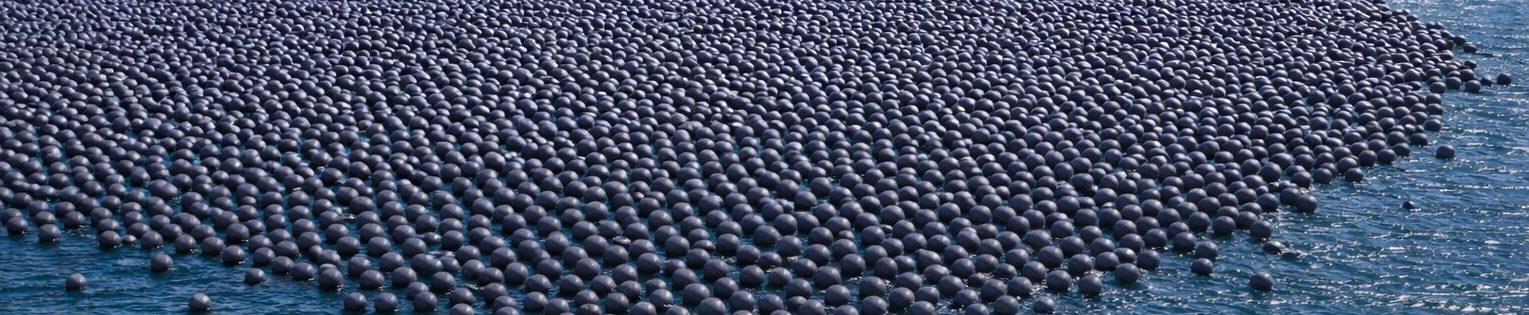
A floating water cover system is a modular surface protection technology that partially or fully covers open water storage basins. The most widely used type uses hollow plastic spheres (typically manufactured from UV-stabilized high-density polyethylene, or HDPE) that float across the water surface, self-organize under wind and current, and collectively form a continuous protective layer.
That floating layer reduces solar radiation reaching the water surface, limits evaporation, discourages wildlife from landing, and helps maintain more stable water chemistry over time. Because the system is modular and requires no structural anchoring or electrical power, it adapts to any basin geometry and coexists with existing infrastructure: aerators, intake structures, and monitoring equipment remain fully accessible.
|
65–80% Evaporation reduction measured in peer-reviewed field studies of floating sphere cover systems |
$1.1B+ Spent by U.S. communities on algae prevention and treatment between 2010 and 2020, per the Environmental Working Group |
10+ yr Minimum service life of UV-stabilized HDPE floating sphere systems under continuous outdoor exposure |
Why Engineers use floating Water Covers
Evaporation reduction
In warm, arid, or high-wind environments, surface evaporation can remove substantial volumes of stored water annually. Peer-reviewed field studies of floating sphere cover systems have measured evaporation reductions of 65 to 80 percent under summer conditions, a meaningful performance gain for any facility where water conservation or storage capacity is a concern.
Algae control
Algae growth is driven by sunlight. Open reservoirs and treatment lagoons are natural bloom environments, and unchecked algae creates cascading operational problems: taste and odor events in drinking water, oxygen depletion in treatment lagoons, increased chemical dosing costs, and biological instability across storage systems. According to the Environmental Working Group, U.S. communities spent more than $1.1 billion between 2010 and 2020 preventing and treating algae blooms, and that figure is widely considered an undercount. Floating covers reduce light penetration at the water surface, cutting off the primary algae growth driver without chemical intervention.
Bird control and wildlife mitigation
Open water surfaces attract birds and wildlife, which introduce biological contaminants and create regulatory compliance exposure for utilities subject to surface water treatment rules. Floating sphere covers create a mobile, unstable surface layer that discourages birds from landing, making them an effective passive wildlife deterrent that requires no ongoing management. Floating sphere covers are also used in stormwater and retention ponds on or near airport property, where wildlife hazard management is a safety and FAA compliance requirement.
Water quality protection
UV exposure drives photochemical reactions in stored water, including the breakdown of disinfectants and the formation of regulated byproducts. A well-known municipal case involved a major U.S. reservoir where a sunlight-driven reaction between chlorine and bromide was producing bromate, a regulated carcinogen, in the drinking supply. Floating sphere covers were deployed specifically to suppress that reaction. Limiting UV exposure at the surface helps maintain more stable water chemistry and extends the window in which stored water holds its quality specifications.
Applications by Sector
Drinking water reservoirs
Municipal utilities use floating sphere systems to protect finished and raw water reservoirs from algae, wildlife, and photochemical degradation. Shade balls, the term most commonly associated with drinking water reservoir applications, are the same modular floating sphere technology applied specifically to potable water storage and water quality protection. Floating covers provide a cost-effective alternative to rigid structural covers while meeting the wildlife deterrence and water quality protection requirements common in surface water treatment programs.
Wastewater lagoons and stabilization ponds
Floating covers are widely used in facultative lagoons, equalization basins, and polishing ponds to stabilize biological treatment conditions. By reducing algae growth without interfering with aeration equipment, floating sphere systems help operators maintain more consistent effluent quality and reduce the operational variability that comes with seasonal algae blooms.
Stormwater retention and detention ponds
Stormwater ponds are difficult to manage chemically and often subject to heavy wildlife activity. Floating covers offer passive algae suppression and bird deterrence without requiring treatment infrastructure. They are a practical option for systems that receive intermittent flow and are managed with minimal operator intervention.
Industrial water storage and cooling basins
Industrial facilities managing cooling water basins, mining water storage, and process water ponds use floating covers primarily for evaporation control. In high-temperature or high-wind environments, evaporative losses from uncovered industrial basins represent both a direct water cost and an operational efficiency loss. Floating covers reduce both.
Desalination brine ponds and recycled water storage
Desalination concentrate management ponds benefit from reduced evaporative losses and minimized salt crust formation at the surface. Recycled water storage applications use floating covers to protect treated water quality between treatment and reuse, maintaining water quality specifications across the storage window.
Floating Balls vs. Floating Membrane Covers
Engineers evaluating reservoir cover systems typically compare floating sphere systems against floating geomembrane covers. Both protect open water surfaces, but they differ significantly in installation complexity, cost, and operational flexibility.
|
Factor |
Floating sphere system |
Floating membrane cover |
|
Installation complexity |
✓ No anchoring, no site prep |
Structural anchoring required |
|
Capital cost |
✓ Lower per square foot |
Higher: structural and material costs |
|
Irregular basin shapes |
✓ Self-adapting, no fabrication |
Custom fabrication required |
|
Equipment access |
✓ Balls float around structures |
Penetrations require engineering |
|
Maintenance |
✓ Replace individual balls as needed |
Seam inspection and patching required |
|
Scalability |
✓ Add balls incrementally |
Full replacement for expansion |
Floating membranes are the right choice when full hermetic sealing is a regulatory requirement: odor containment, certain chemical storage applications, or situations where zero surface exposure is mandated. For most open reservoir, lagoon, and industrial basin applications, floating sphere systems offer better cost-to-performance with significantly lower installation complexity and risk.
Designing a Floating Cover System
Floating sphere cover systems are sized based on four primary variables: total water surface area, target coverage percentage, local wind and environmental conditions, and operational access requirements for existing equipment.
As a general reference, 4-inch (100mm) HDPE balls (the industry standard size) pack at approximately 10 balls per square foot. A one-acre reservoir at 95 percent coverage requires in the range of 400,000 to 450,000 balls. Coverage targets vary by application: drinking water reservoirs typically target 95 to 98 percent coverage, while industrial evaporation control applications may achieve acceptable results at 85 to 90 percent.
Wind exposure is an important design consideration. In high-wind environments, balls may concentrate on the leeward shore, reducing coverage on the windward side. Perimeter containment systems or directional baffles can address this in exposed installations.
GES works directly with engineers and project teams to develop coverage calculations and system sizing for specific site conditions, including irregular basin geometries, variable water levels, and installations with existing aeration or intake infrastructure.
EnviroBalls™ by Global Environmental Solutions
EnviroBalls™ are manufactured in the United States from UV-stabilized HDPE, engineered specifically for municipal and industrial water infrastructure applications. Each EnviroBall™ is a hollow sphere available in black (the standard color for maximum solar blocking), with additional color options available for applications where heat gain or visual identification is a concern.
UV stabilization is not a commodity feature. HDPE formulations without adequate UV additive packages degrade under sustained sun exposure, losing structural integrity and releasing microplastics into the water they are deployed to protect. UV-stabilized HDPE floating sphere systems have a documented minimum service life of 10 years under continuous outdoor exposure, a specification that should be verified for any floating sphere product under evaluation.
For utilities and contractors working on federally funded infrastructure projects, including those funded through the Infrastructure Investment and Jobs Act or state revolving fund programs, U.S. manufacturing ensures compliance with Buy America provisions without sourcing waivers or added procurement documentation burden.
GES engineering support includes reservoir coverage calculations, product sizing, cost estimates, and installation guidance, provided at no cost during the project evaluation phase. If you are assessing floating cover options for a reservoir, lagoon, or industrial basin, contact the GES team to get sizing and specifications for your specific site.
Request Project Information
GES engineers provide coverage calculations, product sizing, and project cost estimates, no commitment required. Contact Global Environmental Solutions to get started.