

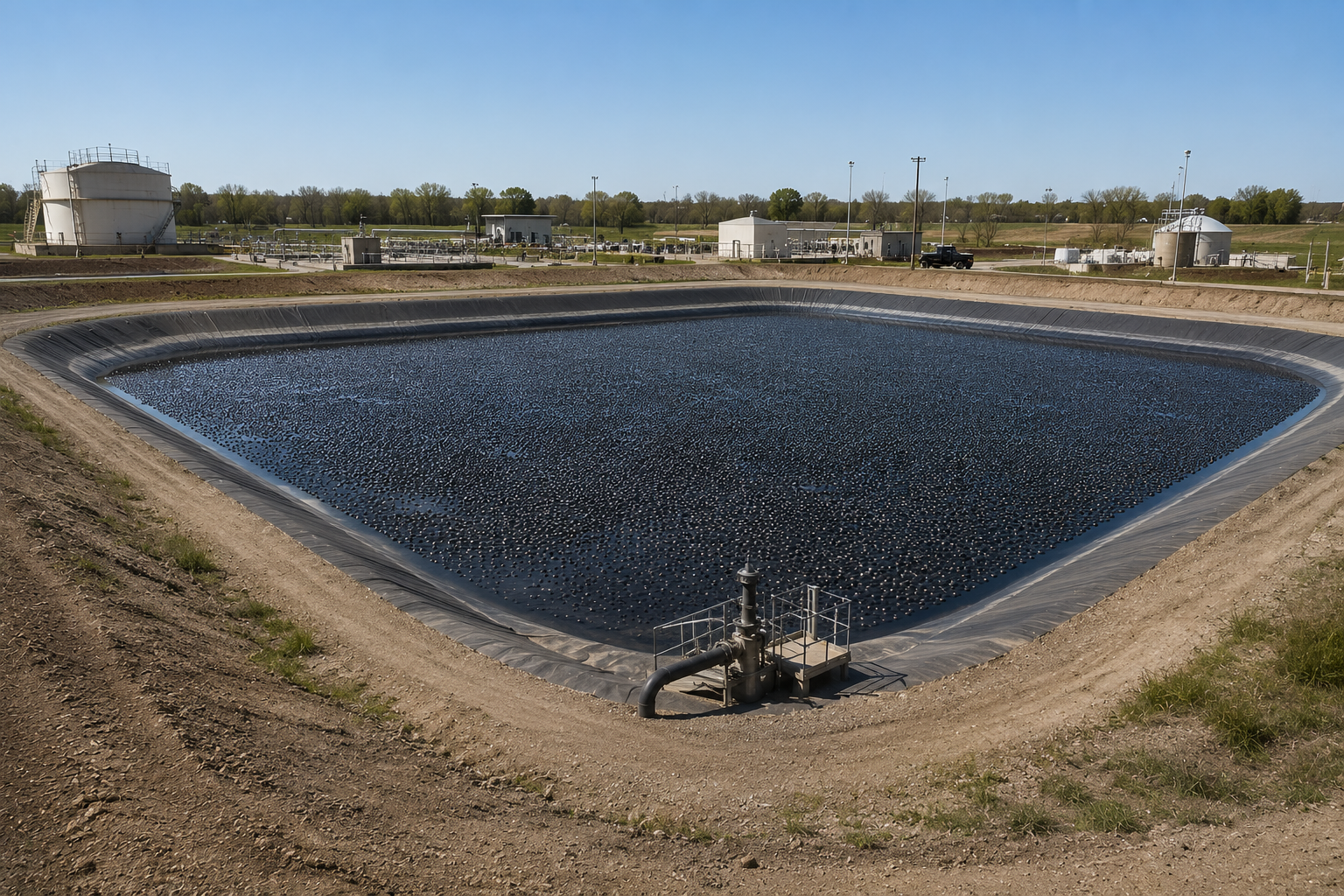
Wastewater lagoons are one of the most cost-effective methods of treating municipal and industrial wastewater, but their large exposed surface area creates operational challenges that become more pronounced over time. Algae growth, odor emissions, and evaporation losses can affect treatment performance, increase operating costs, and create compliance concerns for utilities and industrial facilities alike.
Floating covers address these issues directly by reducing surface exposure while preserving the lagoon’s underlying treatment process. Depending on the application, floating wastewater covers can provide significant reductions in sunlight penetration, evaporation, and odor emissions while requiring minimal infrastructure modifications.
This article examines how floating covers perform in wastewater lagoon applications, which cover technologies are best suited for different lagoon designs, and the factors operators should evaluate when specifying a wastewater lagoon cover system.
Why Wastewater Lagoons Benefit from Surface Coverage
Wastewater lagoons rely on biological treatment processes that are influenced by sunlight, temperature fluctuations, wind exposure, and surface conditions. Open lagoon surfaces are frequently associated with three common operational challenges.
Algae Growth
Sunlight penetrating the water surface promotes algae growth, particularly during warmer months. Excessive algae can contribute to elevated total suspended solids (TSS) in lagoon effluent, increase treatment variability, and create additional operational challenges for downstream processes.
Reducing light penetration through the water surface can help minimize algae growth without requiring routine chemical treatment in many applications.
Odor Generation
Facultative and anaerobic wastewater lagoons may produce hydrogen sulfide, ammonia, and other volatile compounds as part of normal biological treatment processes. When these compounds escape freely from the water surface, nearby residential or commercial areas may experience odor impacts that result in complaints and increased regulatory scrutiny.
While floating covers are not intended to provide complete gas containment unless specifically designed to do so, reducing exposed surface area can significantly reduce odor emissions in many wastewater applications.
Evaporation Losses
In warm, arid, or windy environments, wastewater lagoons can experience substantial evaporation losses over time. Beyond water loss itself, evaporation may increase constituent concentrations and influence downstream treatment requirements.
Floating cover technologies have been shown to substantially reduce evaporation losses in many applications. Actual performance will depend on factors including coverage percentage, local climate conditions, wind exposure, and lagoon geometry.
By addressing algae growth, odor emissions, and evaporation simultaneously, floating covers provide utilities and industrial operators with an additional tool for improving lagoon performance and operational consistency.
Benefits of Floating Covers for Wastewater Lagoons
Floating cover systems may provide several operational benefits, including:
- Reduced sunlight penetration that can help suppress algae growth
- Reduced odor emissions from exposed lagoon surfaces
- Reduced evaporation losses
- Modular installation with minimal infrastructure requirements
- Automatic adjustment to changing water levels
- Compatibility with many aeration and mixing configurations
- Reduced maintenance requirements compared to some traditional cover systems
- Flexible coverage percentages that can be tailored to project objectives
The specific benefits achieved will depend on lagoon design, treatment objectives, operating conditions, and the selected cover technology.
How Floating Sphere Systems Work on Wastewater Lagoons
Floating sphere systems are modular hollow plastic balls that float freely on the water surface and naturally pack together to form a self-adjusting floating layer. Similar technologies have been used for decades in water and wastewater applications to reduce surface exposure while accommodating changing operating conditions.
On wastewater lagoons, floating sphere systems perform several functions simultaneously.
The spheres reduce ultraviolet and visible light penetration that contributes to algae photosynthesis, helping suppress bloom formation in many applications. They also reduce the amount of exposed water surface available for evaporation and the release of volatile compounds that contribute to odors.
Because the spheres float independently rather than functioning as a single connected membrane, they automatically rise and fall with changing water levels without requiring anchoring or tensioning systems.
Floating sphere systems may also be well suited for retrofits because they can accommodate many existing lagoon configurations. Depending on the application, the spheres can move around fixed infrastructure such as mixers, aeration equipment, and sampling locations without requiring significant modifications to existing systems.
Matching the Cover Technology to the Lagoon Type
Not every wastewater lagoon has the same treatment objectives, and the most appropriate cover technology will depend on the lagoon’s specific function.
Facultative Lagoons and Stabilization Ponds
Facultative lagoons are commonly concerned with algae management, evaporation reduction, and odor control. Floating sphere systems can substantially reduce sunlight penetration while allowing coverage percentages to be tailored around treatment objectives and operational considerations.
Aerated Lagoons and Equalization Basins
Aerated lagoons and equalization basins require cover systems that can accommodate mechanical or diffused aeration equipment. Floating sphere systems are often well suited for these applications because they adjust naturally with water movement and can be designed around existing infrastructure requirements.
Polishing Ponds
Polishing ponds frequently use floating covers to minimize late-stage algae growth that may affect final effluent quality before discharge or reuse applications.
Anaerobic Lagoons and Digester Ponds
When complete odor containment or biogas collection is required, sealed floating geomembrane covers are frequently the preferred solution. These systems are capable of providing substantially greater gas containment than modular floating sphere technologies and are often selected when regulatory or process requirements demand full surface sealing.
Selecting the appropriate cover technology should consider treatment objectives, regulatory requirements, equipment configurations, and long-term maintenance expectations.
Floating Sphere Systems vs. Floating Geomembrane Covers
Wastewater lagoon operators evaluating floating covers typically compare floating sphere systems with floating geomembrane covers.
Floating geomembrane covers form a continuous barrier across the lagoon surface and are generally preferred when projects require:
- Biogas collection
- Complete or near-complete odor containment
- Full surface isolation
- Specific permit or regulatory requirements for gas management
These systems typically involve greater installation complexity, including anchoring systems, membrane seaming, and periodic inspection requirements.
Floating sphere systems offer a different set of advantages, including:
- Simplified installation
- Modular and scalable deployment
- No membrane seaming requirements
- Automatic adjustment to changing water levels
- Compatibility with many existing lagoon configurations
For many facultative lagoons, aerated lagoons, equalization basins, and polishing ponds where algae control, evaporation reduction, and odor mitigation are the primary objectives, floating sphere systems may provide an attractive cost-to-performance alternative.
The appropriate solution will ultimately depend on the operational goals of the individual facility.
Sizing a Floating Cover for a Wastewater Lagoon
Proper sizing of a floating wastewater cover involves more than simply calculating surface area.
Engineers should consider:
- Total lagoon surface area
- Desired coverage percentage
- Treatment objectives
- Local wind and climate conditions
- Existing aeration or mixing equipment
- Access requirements for maintenance and sampling
- Regulatory or permit considerations
Coverage requirements are highly application-specific. A lagoon experiencing significant algae issues may warrant a different design approach than one primarily seeking evaporation reduction or odor mitigation.
Proper sizing helps balance performance objectives with project costs while ensuring the selected cover system complements existing treatment operations.
Working With GES on Wastewater Lagoon Coverage
Every wastewater lagoon presents a unique combination of treatment objectives, environmental conditions, and operational requirements. Selecting the appropriate floating cover technology requires consideration of lagoon type, desired performance outcomes, existing infrastructure, and long-term operating expectations.
GES works directly with utilities, consulting engineers, contractors, and industrial operators to evaluate wastewater lagoon cover requirements and develop preliminary sizing and cost estimates for floating sphere systems.
EnviroBalls® floating covers are manufactured in the United States, which may help support domestic sourcing requirements for federally funded infrastructure projects, including certain projects funded through the Infrastructure Investment and Jobs Act and State Revolving Fund programs.
If you are evaluating floating cover options for a wastewater lagoon, contact the GES team for a no-obligation coverage assessment and preliminary sizing estimate tailored to your specific application.